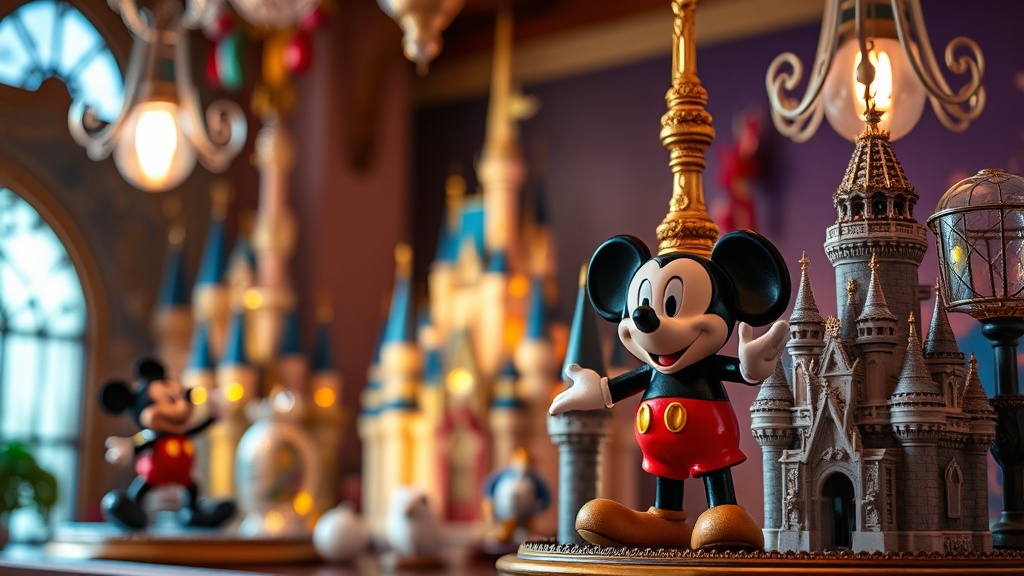
Securing High-End Disney Collectibles from UV Damage

The Faded Mickey Problem
Imagine unboxing a long-awaited, limited-edition Disney figure, only to find the vibrant reds of Mickey Mouse's shorts have turned a dull, sickly pink. Or perhaps you notice a subtle yellowing on the pristine white cape of a high-end Figment figure. This isn't just a bad batch of paint; it's the result of light-induced degradation. Photochemical reactions can alter the molecular structure of plastics and pigments, making light management a top priority for anyone serious about their collection. This post covers how UV rays interact with different materials and how you can prevent permanent discoloration.
Collectors often focus on humidity or dust, but light is a silent thief. Whether it's direct sunlight through a window or the harsh glow of an unshielded LED, light carries energy that breaks down chemical bonds. For high-end PVC or resin figures, this often manifests as color shifting or surface-level brittleness. If you're displaying a piece in a room with large windows, you aren't just risking a little fading—you're risking the long-term structural integrity of the toy itself.
Does Sunlight Damage Plastic Figures?
The short answer is yes, and the process is often irreversible once it starts. Most modern Disney collectibles are made from various types of plastics, including PVC (polyvinyl chloride) and ABS (acrylonitrile butadiene styrene). These materials are highly susceptible to UV radiation. When UV rays hit these surfaces, they trigger a process called photodegradation. This is why an old toy left on a sunny windowsill looks nothing like the one kept in a dark box.
UV rays penetrate the top layers of the plastic and cause the polymer chains to break. This leads to several visible issues:
- Color Fading: Pigments lose their vibrancy as the light breaks down the chemical bonds in the dye.
- Yellowing: This is common in white or clear plastics, where the UV exposure causes a chemical change known as "yellowing" or "ambering."
- Surface Brittleness: The plastic can become physically fragile, making the figure prone to snapping if moved.
To understand the depth of this issue, you might look at the technical aspects of photodegradation to see how energy affects molecular structures. For many collectors, a single faded figure can drop the resale value by 50% or more, making prevention much cheaper than trying to fix it later.
Which Lighting Types Are Safest for Display?
Not all light is created equal. If you're setting up a display, you need to be intentional about your light sources. Standard incandescent bulbs generate heat, which is a double threat because heat and light work together to accelerate plastic degradation. LED lighting is generally the preferred choice for collectors because it produces significantly less heat and lacks much of the UV-heavy spectrum found in older bulbs.
When selecting lights, look for the following specifications:
- UV-Filtered LEDs: These are specifically designed to minimize harmful radiation.
- Low Wattage: Lower power consumption generally means lower heat output.
- Indirect Lighting: Instead of pointing a bulb directly at a figure, try bouncing light off a wall or using a diffuser.
You can often find specialized display lighting through hobbyist retailers, but even a simple LED strip with a frosted cover can do wonders. A great resource for understanding light spectrums and how they interact with different environments is the Department of Energy's guide on lighting efficiency. It helps clarify why some light sources are more aggressive than others.
How Can I Prevent UV Exposure in My Display Case?
If you have a high-value collection, a standard open shelf isn't enough. You need a physical barrier between your figures and the ambient light in your room. Acrylic or glass display cases provide a basic level of protection, but they aren't a silver bullet. Standard clear acrylic can still allow significant UV penetration. If you want to be truly safe, you'll need to look into UV-resistant materials.
Here are a few ways to harden your display against light damage:
- UV-Protective Acrylic: Some high-end display cases use specialized acrylic that filters out up to 99% of UV rays.
- Window Films: If your display is in a room with large windows, applying a UV-blocking film to the window glass can protect the entire room, not just the case.
- Blackout Curtains: The simplest (and cheapest) method is to control the room's environment. Using heavy curtains during peak sun hours can save your collection from the most aggressive rays.
A common mistake is assuming that a closed case is enough. If your room is flooded with sunlight, that light will hit the case and pass right through to the figure. You must address the light source itself, not just the container. A well-protected collection stays vibrant, whereas a neglected one will eventually lose its luster. Remember, once a color has faded due to UV exposure, there is no way to "re-dye" the plastic without risking the figure's value and structural integrity.