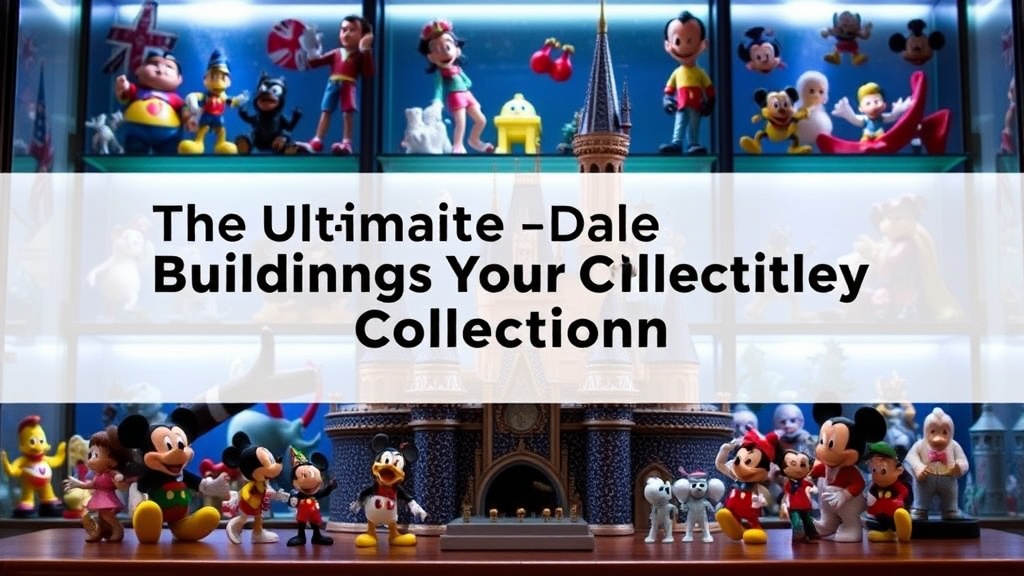
The Ultimate Guide to Building Your Disney Collectibles Collection

What Does This Guide Cover (and Why Should Collectors Care)?
This guide breaks down everything needed to build a Disney collectibles collection that actually matters—no fluff, no generic advice. Whether starting from scratch or refining an existing collection, you'll learn how to spot valuable pieces, avoid costly mistakes, and organize what you've got. The collectibles market hit $458 billion globally in 2024, and Disney sits at the very top of that heap. But here's the thing: not every Mickey Mouse figurine appreciates. Most don't. This guide focuses on what does.
Where Should Beginners Start With Disney Collectibles?
Start with one character or film line—just one. Spreading across fifty different franchises leads to cluttered shelves and empty wallets. Pick a favorite (Frozen, The Lion King, vintage Mickey Mouse) and commit to understanding that niche deeply before branching out.
The best entry points for new collectors include:
- Funko Pop! Disney figures — Affordable ($12-15), widely available, and surprisingly valuable for limited editions
- Jim Shore Disney Traditions — Hand-painted resin figures blending folk art with classic characters
- LENOX Disney figurines — Porcelain pieces that hold value better than resin alternatives
- Disney Store limited releases — Exclusives like the Disney Wisdom Collection or monthly plush series
Beginners often make the mistake of buying everything that catches the eye. Resist this. A focused collection of twenty carefully chosen pieces beats two hundred random impulse buys every time. The former tells a story. The latter just collects dust.
Which Disney Collectibles Actually Hold (or Gain) Value?
Scarcity drives value—true scarcity, not artificial "limited edition" labels slapped on mass-produced items. Original production runs from defunct manufacturers (Applause, Enesco's early lines) often outperform current Disney Store exclusives. Vintage pieces from the 1930s-1960s—celluloid toys, early Disneyland souvenirs, character watches—command serious premiums at auction.
Here's what actually appreciates:
| Category | Examples | Value Range | Appreciation Potential |
|---|---|---|---|
| Vintage Disneyland park items (1955-1980) | Ticket books, ride vehicles, cast member pins | $50 - $5,000+ | High — supply fixed, nostalgia growing |
| Production animation cels | Original hand-painted cels from Snow White, 101 Dalmatians | $200 - $50,000+ | Very High — finite supply, museum interest |
| First-year releases | 1971 Walt Disney World opening merchandise, 1995 first Pocahontas dolls | $75 - $2,000 | Moderate to High |
| Artist-signed limited editions | Ron Lee sculptures, Larry Nikolai originals | $300 - $10,000+ | Moderate — depends on artist reputation |
| Error variants | Misprinted tags, factory paint errors, recalled items | $25 - $1,500 | Variable — niche appeal |
Modern Funko Pop! figures can appreciate— convention exclusives, chase variants, and vaulted (discontinued) lines sometimes reach $200-500. But the vast majority plateau at retail value or depreciate. Don't collect Funko expecting investment returns. Collect them because you enjoy the hunt.
The Villains Exception
Disney villains consistently outperform heroes in secondary markets. Maleficent, Ursula, Scar—these characters appear less frequently in official merchandise, making their pieces rarer by default. A limited edition Maleficent doll from the Disney Designer Collection might retail at $130 and sell for $400+ within months. Heroes flood the market. Villains don't.
How Do You Spot Fakes and Reproductions?
The counterfeit market for Disney collectibles is massive—especially on marketplace sites where "vintage" often means "made last week in an unregulated factory." Knowing what to check saves money and embarrassment.
Red flags that scream reproduction:
- Too-perfect paint — Authentic vintage pieces show minor imperfections; modern fakes often look oddly pristine
- Incorrect materials — Early Disney items used specific plastics, metals, and fabrics that feel different from modern equivalents
- Wrong tags and markings — The Walt Disney Archives maintains records of authentic manufacturer marks; compare carefully
- Provenance gaps — No documentation, no history, no clear ownership chain for high-value items
Celluloid toys from the 1930s-40s present a particular challenge. Authentic pieces carry specific mold marks and yellow differently than reproductions. The smell helps too—real celluloid has a distinct camphor-like scent that decades don't erase. (Yes, really. Smell the collection.)
For high-value purchases—anything over $500—require third-party authentication. Professional Sports Authenticator (PSA) and Beckett Authentication Services both handle Disney memorabilia. The $50-100 authentication fee beats losing thousands on a convincing fake.
What's the Best Way to Display and Store Collectibles?
Display matters almost as much as acquisition. A $2,000 animation cel tucked in a closet might as well be worthless—you can't enjoy it, and condition degrades from poor storage. UV light destroys everything: colors fade, plastics yellow, fabrics deteriorate. Keep valuable pieces away from windows entirely, or invest in UV-filtering glass (not acrylic—acrylic scratches and attracts static).
Climate control isn't optional for serious collections. Ideal conditions run 65-70°F with 45-50% humidity. Basements flood. Attics bake. Neither works for long-term storage.
Specific display recommendations by category:
- Porcelain and ceramic figurines — Glass-front cabinets with LED lighting; avoid halogen heat
- Plush and textiles — Acid-free storage boxes for preservation, shadow boxes for rotation displays
- Vinyl figures and Funko Pops — Stackable protectors maintain box condition; out-of-box display reduces value 30-60%
- Animation cels and art — Museum-quality framing with rag mats and UV glass; never tape or adhesive-mount
- Pins and small items — Cork boards with protective sleeves, or specialized pin folios for storage
The catch? Beautiful display cases cost money—sometimes more than the collectibles inside. Budget accordingly. A $100 figure in a $300 custom case sounds ridiculous until that figure appreciates to $800 and the case protected it.
How Do You Build a Collection on a Realistic Budget?
Not everyone has $5,000 to drop on a vintage Mickey Mouse watch. Smart collectors build systematically—monthly budgets, patience, and strategic prioritization.
The $100/month approach works surprisingly well. That's $1,200 annually—enough for 2-3 quality mid-range pieces or one serious vintage score at auction. The key? Avoid the $20 impulse buys that add up to nothing. Sixty cheap figurines cost the same as six investment-grade pieces, and the latter will be worth something in five years.
Where to find deals:
- Estate sales in retirement communities — Florida, Arizona, Southern California often yield untouched collections from original owners
- Specialty auction houses — Hake's Auctions and Heritage Auctions regularly feature Disney collectibles with lower buyer's premiums than general houses
- Collector conventions — D23 Expo, local toy shows—dealers negotiate in person more readily than online
- Facebook collector groups — Private communities with vetted members offer better prices than public marketplaces
Worth noting: the "deal" that seems too good probably is. A $500 animation cel listed for $50 isn't lucky—it's fake, damaged, or stolen. Verify everything.
When Should You Sell (and How)?
Collections evolve. Tastes change. Financial needs arise. Knowing when to liquidate matters as much as knowing when to buy.
Sell when a piece no longer brings joy—that's the obvious trigger. But also consider selling when markets peak. Disney+ launch cycles, film anniversaries, and actor deaths (morbid but true) create temporary demand spikes. A Black Panther figure might sit at $40 for years, spike to $150 during Chadwick Boseman memorial coverage, then settle back. Timing matters.
Consign high-value items ($500+) through established auction houses. They reach serious buyers and handle authentication concerns. For mid-range pieces ($50-500), eBay with detailed photos and documented provenance works well. Low-value common items? Bundle them in lots, sell at local shows, or donate for tax deductions—individual sales aren't worth the effort.
Building a Disney collectibles collection isn't about acquiring stuff. It's about curating pieces that matter—artifacts of cultural history, personal nostalgia, and genuine craftsmanship. Start small. Learn constantly. Buy what resonates. The collection will grow into something worth having.